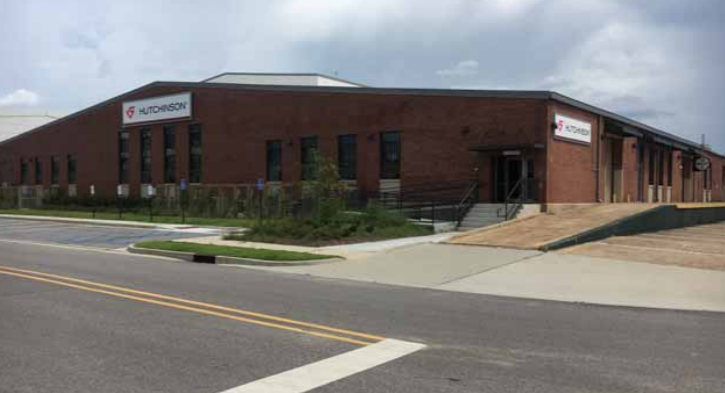


Mobile has been cleaning up and reinvesting in its brownfields since 2009, and the results speak for themselves. Through three EPA Assessment Grants totaling $1.1 million, the City assessed 35 properties across Downtown Mobile, Africatown, the Brookley Aeroplex, and other areas, unlocking sites for office development, expanded businesses, and new industrial tenants. The Brownfields Program transforms properties that complicate redevelopment into properties that drive it.
What is a brownfield?
-
A property where past industrial or commercial use may have left behind contamination
-
A barrier to redevelopment — and an opportunity waiting to be unlocked
-
Assessed through a federally funded, phased environmental review process
-
A catalyst for tax base growth, job creation, and neighborhood reinvestment
-
Found throughout Mobile: former gas stations, machine shops, auto dealerships, military facilities
-
Part of Mobile’s broader commitment to sustainable, community-driven revitalization
How brownfields assessment works
Brownfields assessment follows a phased process, each step building on the last to reduce uncertainty and move a property toward reuse. Not every site goes through every phase; the process stops when enough is known to make a redevelopment decision.
Phase I
Records review & site visit
No sampling. Environmental professionals research ownership history, past uses, and nearby operations, then inspect the site for visible signs of contamination.
Phase II
Soil & water sampling
Soil and groundwater samples are collected and sent to a laboratory. A Quality Assurance Project Plan (QAPP) must be approved by EPA before sampling begins.
Phase III
Supplemental assessment
If contamination is confirmed, additional sampling maps how far it has spread horizontally and vertically through the soil and groundwater.
ABCA
Cleanup planning
An Analysis of Brownfields Cleanup Alternatives evaluates at least three realistic cleanup options, comparing costs and outcomes so redevelopment decisions can move forward.
Mobile’s brownfields program began in 2009, when the City received its first EPA Assessment Grant after two earlier applications. Since then, the City has administered three grants totaling $1 million in federal investment, assessing dozens of properties across Downtown Mobile, the Brookley Aeroplex, and the historic Africatown community.
2009 Assessment Grant ($400,000) Focused on Downtown Mobile and properties surrounding Ladd-Peebles Stadium, the City’s first grant funded Phase I assessments on 11 properties and Phase II or III assessments on 8, with PPM Consultants serving as the Qualified Environmental Professional. The grant ran from October 2009 through September 2012, with $386,903 of the $400,000 expended. The most visible outcome was the Former CarQuest building, also known as the Buick Building, which was assessed under this grant and redeveloped in 2015 into Class A office space, anchoring a wave of reinvestment in that Downtown block.
2014 Assessment Grant ($400,000) The second grant targeted the Brookley Aeroplex and three surrounding census tracts. PPM Consultants again served as QEP, with E3 Solutions providing community outreach. The grant funded assessments of three major Brookley buildings, including Building 14, which has since been renovated and occupied, as well as the Former Merritt Oil property on South Conception Street. The grant ran through September 2017, expending $382,357.
FY2020 Africatown Assessment Grant ($300,000) Mobile’s third and most recent grant was specifically awarded to address environmental concerns in the Africatown community, one of Mobile’s most historically significant and environmentally burdened neighborhoods. CERM served as QEP. The grant ran from October 2020 through September 2024, with $296,199 expended. Six properties were assessed, two received full cleanup alternative analyses, and a GIS-based brownfields site inventory was developed for the community’s ongoing use.
Throughout all three grants, EPA Region 4 has provided project oversight and ADEM has provided regulatory guidance. The City has submitted quarterly performance reports and maintained up-to-date records in EPA’s Assessment Cleanup and Redevelopment Exchange System (ACRES) database, which tracks outputs and outcomes for every assessed property.
City of Mobile The City of Mobile serves as the Cooperative Agreement Recipient for all three brownfields grants, responsible for implementing the program, meeting grant objectives, and maintaining all project records.
U.S. Environmental Protection Agency, Region 4 EPA Region 4 provides grant oversight and monitors all activities to ensure they are consistent with the approved work plan. EPA also maintains the ACRES database where all project outputs and outcomes are tracked.
Alabama Department of Environmental Management (ADEM) ADEM provides regulatory framework and compliance guidance, reviews applicable reports and plans, and approves site-specific cleanup plans as appropriate.
PPM Consultants, Inc. Based in Spanish Fort, Alabama, PPM served as Qualified Environmental Professional for the 2009 and 2014 Assessment Grants, conducting all Phase I, II, and III ESAs and preparing ABCA reports for both grant cycles.
Corporate Environmental Risk Management, LLC (CERM) Based in Mobile, Alabama, CERM served as Qualified Environmental Professional for the FY2020 Africatown Assessment Grant, conducting all site assessments and cleanup alternative analyses and managing grant reporting.
E3 Solutions, Inc. E3 Solutions provided community outreach and environmental justice training for the 2014 Assessment Grant.
Documents
City of Mobile EPA Brownfields Assessment Grant, Final Report (2009 and 2014 Grants)
City of Mobile Africatown FY2020 EPA Brownfields Assessment Grant, Project Closeout Report (January 2025)
ACRES database
What is a brownfield? A brownfield is a property where the presence or potential presence of a hazardous substance, pollutant, or contaminant complicates its reuse or redevelopment. Brownfields are common in older cities and industrial areas: former gas stations, dry cleaners, auto shops, warehouses, and manufacturing facilities are all typical examples. Many brownfields are not heavily contaminated, but uncertainty about what’s there is enough to stall investment. The assessment process resolves that uncertainty.
How are sites selected for assessment? Sites are identified through community input, stakeholder discussions, and reconnaissance of the grant’s target area. A scoring and prioritization process evaluates each candidate site based on factors including economic development potential, environmental conditions, property owner participation, and proximity to sensitive populations. Sites also must have owner cooperation, as a signed site access agreement is required before any assessment work can begin. Sites where owners decline access, or where another program such as Alabama’s Tank Trust Fund is already handling remediation, are generally not eligible.
What happens after a Phase II ESA? It depends on what the Phase II found. If contamination is confirmed, the City and property owner work with ADEM to determine next steps, which may include a Phase III assessment to define the extent of impact, an ABCA to evaluate cleanup options, or enrollment in ADEM’s Voluntary Cleanup Program. If the Phase II finds no contamination above action levels, the property is effectively cleared, and that result can be a powerful tool for attracting redevelopment. In either case, results are documented in EPA’s ACRES database and made available to the public.
Can I report a potential brownfield site? Yes. If you know of a property in Mobile that has a history of industrial or commercial use and may be a candidate for brownfields assessment, contact the City of Mobile’s Environmental Services office. Community input has been central to site identification in all three of Mobile’s brownfields grants, and the FY2020 Africatown grant established a GIS-based site inventory specifically to capture and track community-identified sites for future assessment cycles.
How do I find out if a property I’m interested in has been assessed? All properties assessed under Mobile’s EPA Brownfields grants are tracked in EPA’s publicly accessible ACRES database. You can search by address or property name here. The City of Mobile also maintains a GIS-based brownfields site inventory. Contact the Environmental Services office for access. For the Africatown area specifically, the FY2020 grant produced a site database covering 22 identified properties across the community.
27
Properties Assessed
$
1,100,000EPA Grant Funding
Program in Action
Bringing Brownfields Assessment to a Historic Community
Africatown sits three miles north of downtown Mobile. It’s a community steeped in one of America’s most extraordinary stories of survival and resilience. It is also a community that has lived alongside heavy industry for more than 80 years. More than half of Africatown’s 1,873 acres is industrial land and greenspace covers less than one percent. By every measure tracked by the EPA’s Environmental Justice screening tool, Africatown’s residents face environmental burdens at or above the 95th percentile nationwide. The Africatown story is not just about contaminated parcels. It’s about a community whose environmental burden has been documented, named, and is now being addressed with federal dollars and local commitment.
In 2020, the City of Mobile secured a $300,000 EPA Brownfields Assessment Grant specifically targeting the Africatown community; the third EPA brownfields grant the City has received, and its first focused on environmental justice. The grant funded site inventory, environmental site assessments, community outreach, and cleanup planning across a community that has had too few of each.
What the grant found. Working with consultant CERM, the City identified 22 potential brownfield sites in Africatown and assessed six of them. The two most significant assessments — the Josephine Allen Housing Complex and Lewis Landing #1 — revealed real contamination: arsenic and volatile organic compounds at the former public housing site; arsenic, cadmium, and lead at Lewis Landing, a 1.82-acre parcel where auto body and truck repair operations left their mark on soil and groundwater. Both sites received full Analysis of Brownfields Cleanup Alternatives reports in early 2024, laying the groundwork for what comes next.
What’s ahead. The cleanup planning is already catalyzing investment. Mobile County has plans to redevelop Lewis Landing into a public boat launch and passive green space with access to Three Mile Creek. The State of Alabama has committed $1.5 million in Gulf of Mexico Energy Security Act funds to make it happen. The Mobile Housing Authority is exploring the sale and transformation of the 43-acre Josephine Allen site, with community-driven ideas ranging from a museum anchoring Africatown’s heritage tourism to recreation of the historic village. The Shell Bayou Elks Lodge, assessed for asbestos and lead, is being eyed for a new business startup.
The work is not finished. Of the 22 sites identified, more than a dozen could not be fully assessed due to access challenges. The City has made clear that further assessment, cleanup, and community-aligned redevelopment remain priorities. The 2020 grant is a beginning, not a conclusion.
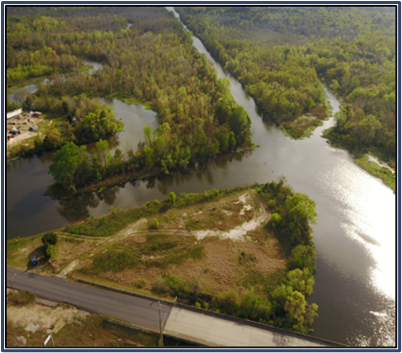
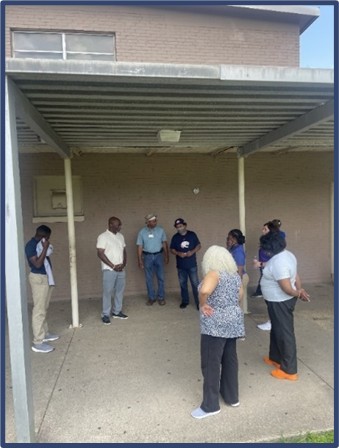
The 2014 Assessment Grant was specifically awarded by the EPA to target the Brookley Aeroplex and three surrounding census tracts. Several projects were located within District Three and many are in blighted areas. The efforts of this work support the City’s commitment to revitalizing historically underserved areas. The assessments completed in this Grant Cycle also supported the Brookley Aeroplex Master Plan, with a stated goal of positioning Mobile as a premier industrial hub in the South.
Several suites within one of the main sites has been renovated and occupied by several tenants, providing significant benefit to the community. The 2014- 2017 period also represented a significant increase in community engagement as part of the assessment and cleanup process, ensuring that funds were going to projects that most benefitted the community.