
Provide input to help guide the DDD update
On Wednesday, September 2, the City hosted a community workshop to gather input to shape the DDD update. If you missed that meeting or have more to share, you can still provide input using the form below.
This form is currently closed for submissions.
What is the Downtown Development District?
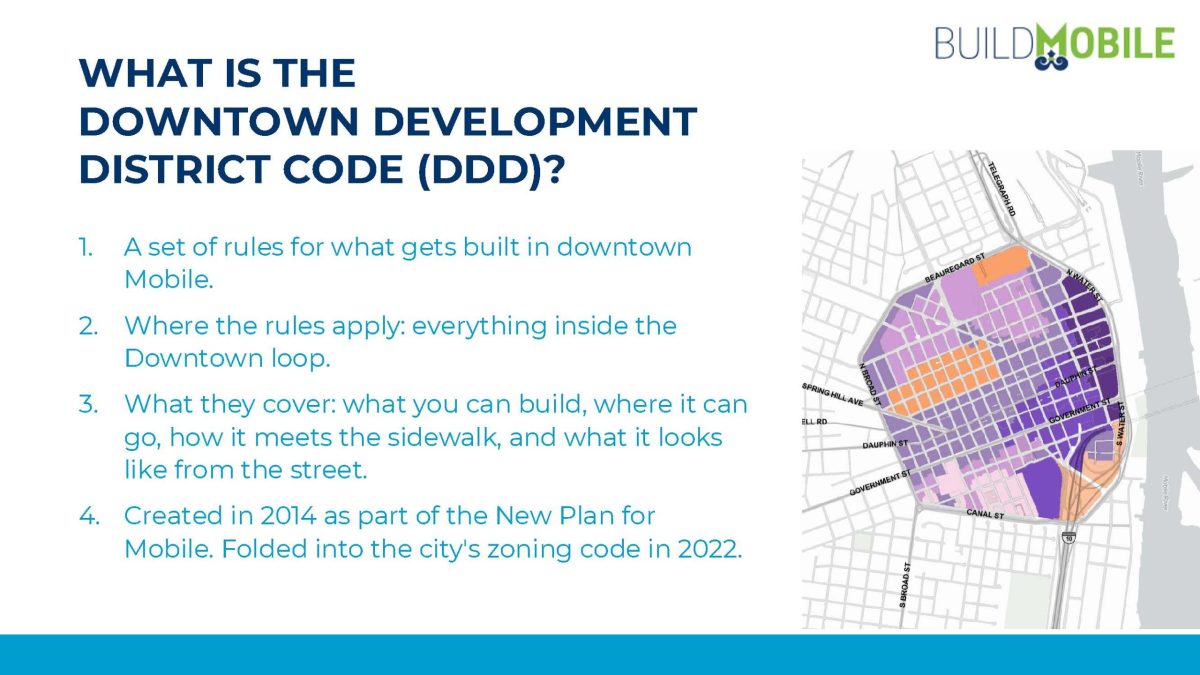
The Downtown Development District (DDD) is a set of zoning rules and development standards that are intended to ensure that new development and redevelopment fits into and complements the historic walkable fabric of downtown Mobile. The DDD was first established in 2014 as part of the New Plan for Mobile. It reflects more than a decade of community input and has helped to support significant investment in downtown.
Why is the DDD being updated?
In the decade since the DDD was created, property owners, developers, and City staff have run into places where the standards are unclear, harder to work with than intended, or not producing the results everyone hoped for. When Mobile rewrote its citywide zoning code (adopted in 2022), the DDD was incorporated into the code, but was not substantially updated. A new format and organization to the DDD was adopted in early 2026, which paved the way for future updates to the code’s substance. Now it is time to consider updates that will make downtown development easier to navigate and more reliably produce the kinds of outcomes the community wants.
What might change?
We’re not starting over. The update is focused on four areas: how the approval process works, design standards for buildings and storefronts, what uses are allowed and where, and any other issues the community identifies. This input will be combined with other previous interviews with regular code users that identified specific issues to address. This is not intended to be a rewrite, but rather a targeted update to improve the DDD.
Does this affect my property?
If your property is within the DDD boundary (within the Downtown loop), yes. The standards in the code apply to new construction, major exterior renovation, or change of use you might undertake. The meeting is a chance to weigh in before changes are finalized.
Will my input matter?
Yes. Feedback gathered at the September 2 meeting will be used to shape the draft amendments before they go to the Planning Commission and City Council. A second round of engagement will follow later in the fall to get feedback on the draft code’s direction before anything is formally adopted.
What if I can't make it to the September 2 meeting?
There will be a survey available on this page later in September. Also, a second round of input will share proposed ideas prior to the formal adoption process.
What's the timeline?
The goal is City Council adoption by early 2027.
About the UDC
The Unified Development Code (UDC) is the City’s zoning and land development regulations intended to implement the recommendations set forth in Map for Mobile. The UDC sets rules, standards, and procedures to guide new development or redevelopment in Mobile.
The UDC will help Mobile strengthen neighborhoods, remain economically competitive, and create great places for people.
The UDC was adopted by City Council on July 12, 2022 after a series of public hearings. The UDC will go into affect in the first quarter of 2023 following the adoption of the updated subdivision regulations.
The initiative of modernizing the City’s zoning code came out of the extensive public input process for the Map For Mobile. In January 2016, the City kicked off the process of developing the Unified Development Code. The process began with the creation of the Future Land Use Plan, which involved several community workshops during 2017. Following the Future Land Use Plan’s adoption, the City worked with a consultant team and a Technical Advisory Committee to draft the regulations. An initial draft of the code articles was released for public comment in late 2017 and early 2018. UDC Version 2 was released for public comment in early 2019. UDC Version 3 was released for public comment in early 2020. The UDC (Version 4) was considered for adoption in early 2021.

1. How is the UDC different from a typical zoning ordinance? A unified development code is a modern approach to regulating development. It is an adopted law of the city that combines the zoning ordinance and other land development regulations into a single document. The zoning ordinance defines different districts that govern the types of uses and the location and size of development in each district. It also includes provisions that establish the procedures for how development proposals are reviewed and approved or denied, and development and form standards such as those covering parking, landscaping, signs, building location and form, and resource protection. The land development regulations, also part of the UDC, regulate the division and platting of land, prior to its development. They include regulations that govern lot division, road layout and standards, and other infrastructure requirements.
2. How does the UDC relate to Map for Mobile? Map for Mobile is the City’s comprehensive plan that provides direction and guidance to improve Mobile and prepare it for the growth on the horizon. The plan presents goals and policies upon which future planning, regulations and decisions can be built. To implement Map for Mobile (the city’s vision), the Future Land Use Plan and Future Land Use Map (FLUM) was adopted to provide more specific guidance on the character of future land use throughout the city. Map for Mobile and the FLUM are policy guides, not legally binding documents. The UDC (as proposed) would be the adopted law of the city that would implement the policies in Map for Mobile and the FLUM.
3. What is the FLUM? The FLUM is the City’s adopted future land use map. It is part of the Future Land Use Plan that was adopted following Map for Mobile and is the primary guide to the future physical development of the City. The map and its corresponding land use designations describe the desired types, intensity, and spatial arrangement of the City’s land uses to achieve the vision described in Map for Mobile. It is not legally binding, but is a policy guide that is used to evaluate potential zoning changes or proposals that require conditional review.
4. What is the Zoning Technical Advisory Committee? The Technical Advisory Committee consists of 15 members appointed by the Mayor that has been responsible for providing review and comment to the City and its planning consultants regarding the zoning code as drafts are prepared. The Committee includes local design professionals, representatives from major stakeholder groups (including corporate, environmental, academic communities, and neighborhood and civic groups), and users of the code.
5. What about the Zoning Map? As of Version 3 (March 2020), the UDC uses the existing zoning district names. No revisions to the zoning map are proposed in the UDC. Adoption of the UDC will not change the existing zoning map.
Status
Ongoing- NextPublic work session to inform an update to the Downtown Development District (DDD) code. Wednesday September 2, at 6:00 PM National Maritime Museum of the Gulf
Updated Aug 14, 2026
Previously approved amendments: March 2025 – April 2026
- DDD Update, Planning Commission Approved April 2026
- DDD Update Presentation to Planning Commission (summary of changes)
- Proposed Ordinance re Downtown Parking Exemption
- Ordinance to Amend Recording paragraphs
- Ordinance to Amend Section 64-5-4 Neighborhood Meetings
- Ordinance to Amend section 64-5-8 Previously Approved PAs and PUDs as revised
- Ordinance to create 64-5-8.1 Terminating a Previously Approved PUD
- Ordinance to Amend Section 64-8-2 – definition of “Lot of Record”
- Historic Avenue Overlay Article
- Historic Avenue Overlay Map
Adopted Code Articles (July 12, 2022)
The Unified Development Code is written in a way that allows readers to quickly find information that is of interest to their property or neighborhood. The most frequently used information is contained in Articles 2, 3 and 4.

David Clark, Visit Mobile President and CEO

Mike Rogers, Rogers & Willard President

Kelly Warren, Family Health Clinical Services Executive Director

Makeda Nichols, State Farm Insurance owner and agent

Bill Sisson, Chamber of Commerce President and CEO

Daniel Dennis, Roberts Brothers Inc President
Learn how the UDC will improve Mobile.
What’s important to you?
Improving neighborhoods. Mobile loves its neighborhoods. The Unified Development Code (UDC) works to ensure the protection of your investments, property values, and quality of life so that our neighborhoods continue to thrive.
One way the code does this is to retain existing neighborhood protections and introduce a distinction between urban and suburban development to guide site standards.

Protecting the Environment is a clear direction in Map for Mobile and the city’s zoning regulations are an important tool to achieve that. The UDC introduces new provisions for protecting Mobile’s natural resources that will result in long-term environmental benefits.
One way the code does this is to introduce the concept of riparian buffers into the city’s regulations (a first for Mobile). Riparian buffers help to protect water quality, reduce erosion, and support wildlife habitats by preserving natural areas adjacent to major waterways and flood prone areas.

Supporting Sound Development. The UDC is a more modern and flexible approach to regulating development. While the code requires a little more work up front, that effort pays off in the end with a streamlined approval process that is more predictable and consistent.
One way the code does this is by establishing provisions that encourage mixed-use projects, that promote flexibility in site design, and support appropriate use of land throughout the City. Also, the new Table of Uses provides for development ‘by-right’ for many types of projects, ensuring predictability.

Strengthening our Economy. The UDC encourages investment through its streamlined development process, but it also contains new provisions that reflect modern practices in land use planning and economic development.
One way the code does this is by incorporating form-based standards to guide the form or design of development sites and new buildings. The standards are not universally applied across the city, but vary based on location, supporting existing development patterns and community identity.


view the existing zoning map
